
Dyer County Obituary Records
Dyer County obituary records are especially useful because the county has archives, museum, historical society, genealogy group, library, and funeral home material that all help with death research. If you are trying to identify a family line in Dyersburg or a nearby community, there are several good entry points. The county records begin early enough to connect an obituary to marriages, deeds, probate, and death indexes. That makes the county strong for a search that starts with a notice and ends with a verified family trail.
Dyer County Quick Facts
Where to Find Dyer County Obituary Records
The Dyer County Archives is one of the strongest local resources in this batch. The archivist, Marilyn Holmes, keeps county records, historical documents, genealogy materials, and photograph collections by appointment. That is a major asset for obituary work because the best death notice is often the one tied to a file you can actually inspect. The county museum, historical society, and genealogy group add even more context. If a notice names a church, a family cemetery, or a relative who lived in another county, the local archive can help you sort it out.
Dyer County also has McIver's Grant Public Library, which holds a Tennessee history and genealogy collection, local newspapers on microfilm, family history files, and census records. That gives you a second strong place to start. The county clerk records begin with marriage and death registration notes, and the register of deeds helps with land records from 1820. That means Dyer County obituary research works best when you keep all the local sources in view at the same time.
For a county with strong records and active local institutions, Dyer County is unusually friendly to serious obituary research.
Dyer County Obituary Sources
The main local web source in the manifest is Dyer County TNGenWeb. It is a useful first stop because the county research notes point to free transcriptions, cemetery work, and family history material. The local page also helps when a surname is common and you need to know which family branch belongs in Dyer County. That is important here because the county has strong community material and a long record run.
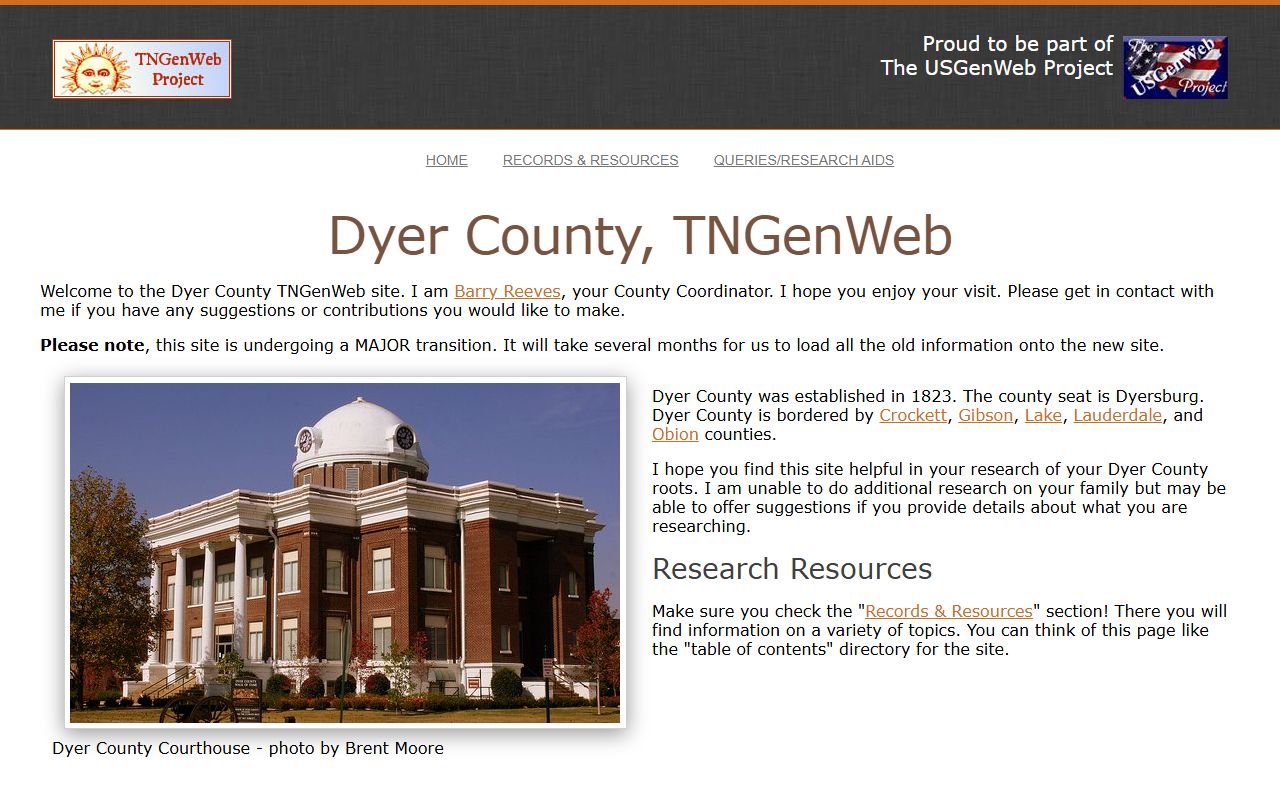
The TNGenWeb page can help you move from a death notice to the right family line. It is a simple but effective starting point.
The Dyer County obituary trail also benefits from the local death transcription page at Genealogy Trails. The research notes show that transcription fields can include certificate number, age, race, marital status, parents, birthplace, cause of death, and burial location. That is exactly the sort of detail that can turn a brief obituary into a solid proof chain. It is especially useful when the obituary is thin but the funeral home or burial note is rich.
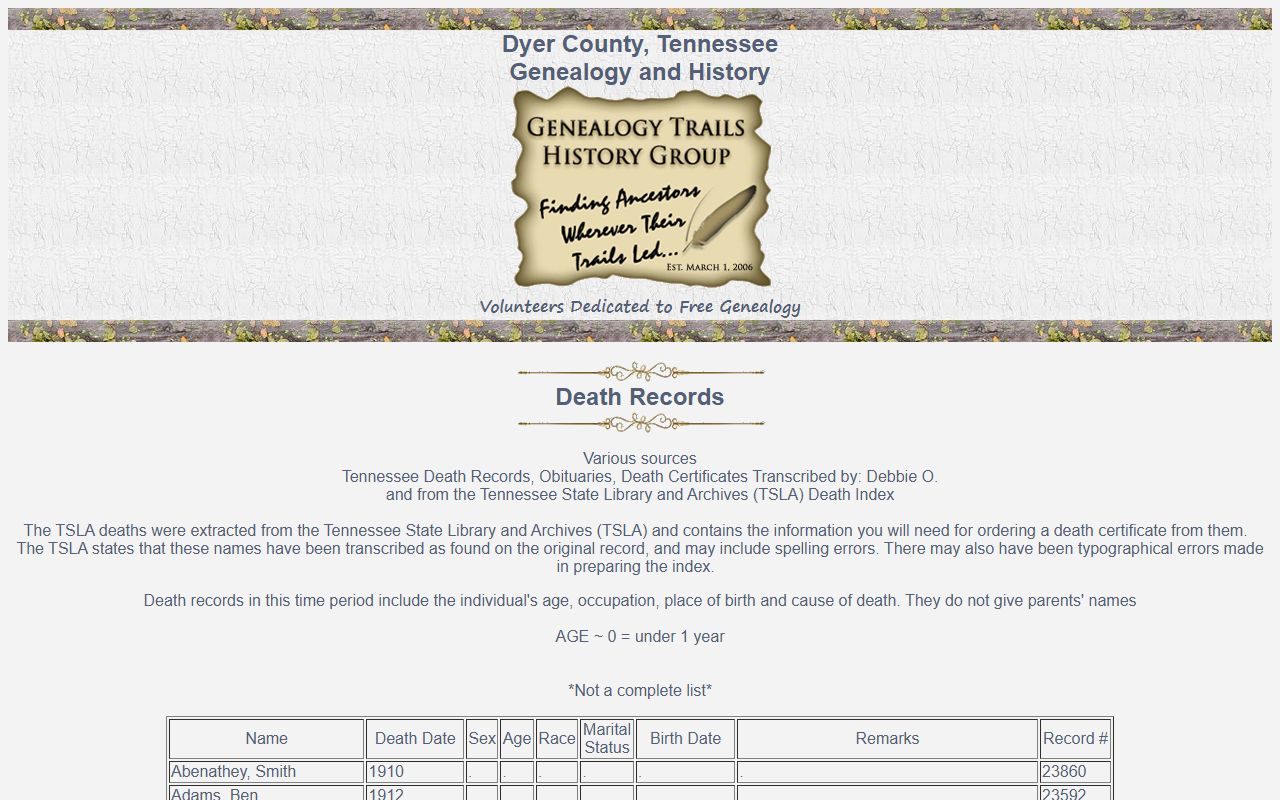
That transcription page is worth checking early. It can do the work of several small searches at once.
Dyer County also has a strong local archives and funeral-home tradition. The TSLA vital records guide explains how county material and state material fit together, and the county's funeral home records at TSLA are unusually rich. For obituary work, that mix is important. It means you can often find the person in the archive, the newspaper, and the funeral home file without leaving the county's record world.
That is rare enough to matter. When a county gives you archives and funeral home records, you use them both.
Search Dyer County Death Records
Dyer County death research moves quickly when you combine the local death transcriptions with the state death indexes. The research notes point to Tennessee death records for 1908-1912 and 1914-1933, and those indexes are often the key to confirming an obituary name. They give you a date, a certificate number, and other biographical fields that can be checked against the local notice. That makes them useful when the obituary is incomplete or when two people with the same name lived in the county.
Certified records still follow Tennessee rules. Death, marriage, and divorce records are restricted for fifty years, while births are restricted for one hundred years. The entitlement guidance and the Tennessee Department of Health's Vital Records pages explain who may request official copies and how the state handles them. That matters less for a public death notice and more for a legal copy request. If you only need the proof trail, the obituary plus the transcription page is often enough.
Use the county archive, the funeral home records, and the state index as one chain. In Dyer County, that chain is strong.
- Full name and any spelling variation
- Approximate death year or burial year
- Funeral home, cemetery, or church clue
- Spouse, parent, or child names
- Archive, newspaper, or transcription note
Dyer County Obituary Images
The local image sources show why Dyer County is such a strong research county. The TNGenWeb page is one route, and the Dyer County death records transcription page is another. Together they mirror how local obituary research actually works here: one source gives you the family trail, and the other gives you the record detail.
The combination saves time when a name appears in a newspaper clipping but not in a modern index.
Because Dyer County also has archive and funeral-home holdings, the local image sources are more than decoration. They point to the exact record types you are most likely to use when a death notice is short or the family is complex. That is a practical advantage, not just a visual one.
Dyer County Public Access Notes
Most obituary material is public. Newspapers, county transcriptions, and many archive materials are open unless a specific restriction applies. Certified death records still follow Tennessee access rules, including the fifty year rule for death, marriage, and divorce records. The Tennessee Public Records Act and the vital records rules are separate layers, and Dyer County research benefits from keeping both in mind. A public obituary can guide the search, but it does not replace the official copy if you need one for a legal purpose.
If you are not sure where to begin, start with the archive, then the library, then the state index. Dyer County is one of the few places where that order usually works very well.