
Search Lawrence County Obituary Records
Lawrence County obituary records are among the easiest in Tennessee to work with because the county archives, courthouse records, newspaper collections, and cemetery survey all sit close together in the record trail. Lawrenceburg is the county seat, and the county archive is built to preserve and share permanent records in a timely way. That means a search can move from a death notice to a county file, then to a cemetery survey or a newspaper issue without much friction. If you want a county where obituary research can go deep, this is one of the best.
Lawrence County Quick Facts
Lawrence County Obituary Sources
Lawrence County was established in 1817 and named for James Lawrence. The county has excellent record survival, which makes obituary work especially productive. The Lawrence County Archives on Highway 43 South in Leoma is the key local research stop. It preserves court records, marriage licenses, wills, probate, deeds, tax records, maps, cemetery surveys, and newspaper holdings. That is a rare mix, and it means a death notice can be tested against several record types without leaving the county system.
The archives are also unusually researcher-friendly. Paper copies are fifteen cents per page, certified documents are one dollar, and scans by email are free. The archives can provide certified marriage copies for marriages performed in Lawrence County up to 2000. It also holds a survey of all known cemeteries, which includes names, locations, and burial dates. Because the newspapers are not indexed, a good date range is important, but the archive still makes the search manageable.
| Archives | 2588 Highway 43 South, Leoma, TN 38468 |
|---|---|
| County Clerk | 2406 Highway 43 S, Lawrenceburg, TN 38464 |
| Public Library | 519 E. Gaines Street, Lawrenceburg, TN 38464 |
| Historical Society | P.O. Box 523, Lawrenceburg, TN 38464 |
Lawrence County obituary research works well because the archive, the county clerk, the library, and the genealogical society all support one another. If the obituary mentions a church or cemetery, the county survey or newspaper holdings can usually confirm it fast. That is especially useful when the notice includes family survivors or a property clue.
The Lawrence County TNGenWeb page at tngenweb.org/lawrence is a strong starting point. It points to local death records, obituaries, cemetery records, and family files.
That page is useful because the county already has excellent record survival, so the local site can help you move quickly to the right source.
How to Search Lawrence County Obituary Records
Begin with the Lawrence County Archives. The archive is the best local stop because it keeps permanent records from 1818 through the mid-1990s, including court records, marriage licenses, wills, probate, deeds, tax records, and maps. It also has a large newspaper collection with obituaries from the Democrat-Union, the Lawrence County Advocate, and other surviving local papers on microfilm. Since the newspapers are not indexed, you should give the archive a specific timeframe when you ask for help.
The archives also keep cemetery survey material and local history records. That matters because a cemetery name in an obituary can be checked against a county survey that lists names and dates of those buried. If the obituary mentions a property or church, the archives can sometimes connect the name to a map or deed. That kind of cross-checking is one of Lawrence County's biggest strengths.
The county clerk and register of deeds are both important, too. The clerk has marriage records from 1818 and limited birth and death records, while the register of deeds has land records from 1819. Those records can support a death notice by showing a spouse, an estate clue, or a property location. The Lawrence County Public Library and the Lawrence County Tennessee Genealogical Society are also useful if you want a second local opinion.
Statewide sources still matter. TSLA's death indexes cover 1908-1912 and 1914-1933, and the Tennessee Office of Vital Records gives you the certified copy path for modern records. The state office is the right place when you need the formal death record behind the obituary. Under T.C.A. 68-3-205 and T.C.A. 68-3-206, access and copy rules depend on age and requester status, so the archive or obituary may actually be the faster route in many cases.
Lawrence County also has no recorded record loss in the research notes. That makes it one of the clearest counties for obituary work in this batch. The archive can often replace the need to jump between several offices.
Note: Lawrence County obituary research is usually fastest when you start at the archive and only leave it when you need a state copy.
- Full name and maiden name if relevant
- Approximate death date or newspaper issue
- Cemetery, church, or funeral home clue
- Residence or family property clue
- Any spouse or child names
With those clues, the archive can usually get you to the right record set quickly.
The Lawrence County Archives is unusually complete. That is why obituary work here can turn into a full family and property search in one visit.
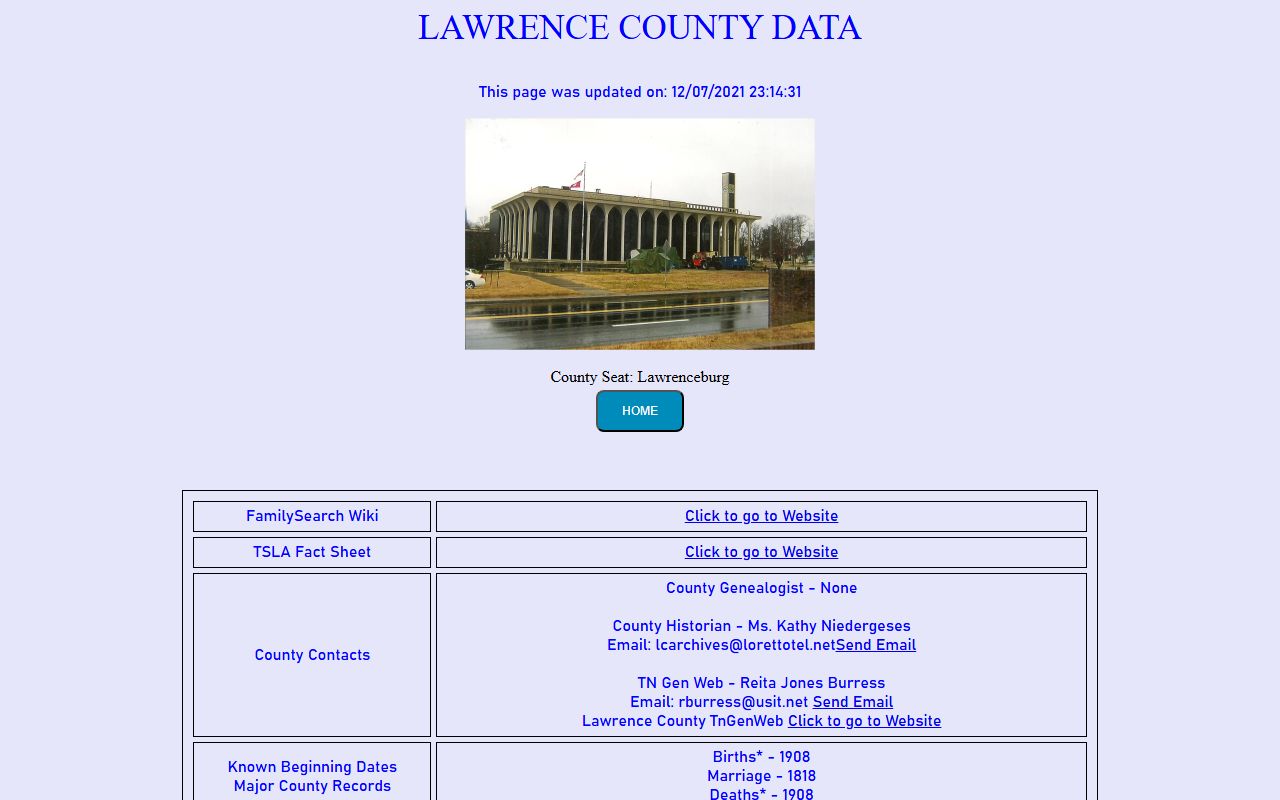
The county society page helps you compare that archive trail with a broader county reference before you make a copy request.
Lawrence County Obituary Records and Archives
Lawrence County obituary records are strongest when you use the archive's newspaper and cemetery holdings together. The Democrat-Union archive is especially useful because it carries extensive obituary coverage. The county also has the Lawrence County Advocate on microfilm up to 1999. Since the papers are not indexed, a date range helps, but the archive's staff can still look up obituaries with a date of death. That is a big advantage for family researchers.
The cemetery survey is another major asset. It lists names, cemetery locations, and buried dates, and it can sometimes include exact grave information. If a notice names a church or a farm, that survey can put the person in place quickly. The county archive also digitized some microfilmed records for Ancestry and FamilySearch, which gives you another route when you want to work from home first and confirm later in person.
For official copies, the Tennessee Department of Health Office of Vital Records remains the state source, but Lawrence County's local archive often supplies enough detail to make the copy request precise. That saves time and lowers the chance of requesting the wrong person. Certified documents at the archive cost one dollar, scans by email are free, and paper copies are fifteen cents per page. Those prices make it easy to order only what you need.
Lawrence County obituary work is also helped by the local genealogical society, which can provide publications and research assistance. The county's records are so complete that you can often start with the notice, then use the archive to build the entire family context around it.
That is why Lawrence County is one of the strongest obituary counties in Tennessee.
Note: In Lawrence County, the archive is not just a backup. It is the main engine of the search.
The archive can also help you narrow a newspaper search because it keeps the surviving local papers and the cemetery survey in the same research flow. That saves time and keeps the search tied to the county record base.
If you have a good death date, you are already close in Lawrence County.
Browse More Tennessee Records
Lawrence County fits into the wider Tennessee obituary and vital-records network. Use the browse pages if the family trail extends past Lawrenceburg.