
Search Rhea County Obituary Records
Rhea County obituary records are a strong research set because the county kept a good amount of material even after two courthouse fires. Dayton is the county seat, and the search trail can move from county records to Rhea County obituaries, TSLA death indexes, funeral home material, and cemetery lists with map support. That means a death notice often becomes a full local research path. If you start with a name and a year, Rhea County usually has enough surviving material to tell you whether you have the right person.
Rhea County Quick Facts
Rhea County Obituary Sources
Rhea County was established in 1807 from Roane County. The county clerk at 375 Church Street keeps marriage records from 1808 and birth and death records from 1908. The chancery court clerk and master in the Dayton courthouse basement handles probate records from 1825. The county's history includes fire damage in 1869 and 1927, but the research notes say marriage records remain intact. That makes Rhea County a solid place to do obituary work because the county records and the local obituary trail still line up well.
The Rhea County TNGenWeb records-resources page at tngenweb.org/rhea/records-resources is a major local hub. It points to obituaries, death indexes, probate books, individual cemetery listings, census records, and original wills. The Genealogy Trails death records database at genealogytrails.com/tenn/rhea/deaths.html is another strong source, especially for 1908-1912 deaths. If a notice is missing from one place, the other often fills the gap.
| Courthouse | 1475 Market Street, Dayton, TN 37321 |
|---|---|
| County Clerk | 375 Church Street, Suite 215, Dayton, TN 37321 |
| Chancery Court | 1475 Market Street Basement, Dayton, TN 37321 |
| Historical Society | Rhea County Historical and Genealogical Society |
Rhea County obituaries are also helped by the county's newspaper history. Dayton, Rhea Springs, and Spring City newspapers appear in the research notes, and TSLA microfilm can be requested through interlibrary loan. That is useful when the obituary is older than the online index or when the family used a nearby town paper rather than the main county paper.
The Rhea County records-resources page at tngenweb.org/rhea/records-resources is the best first stop for local obituary and death index material.
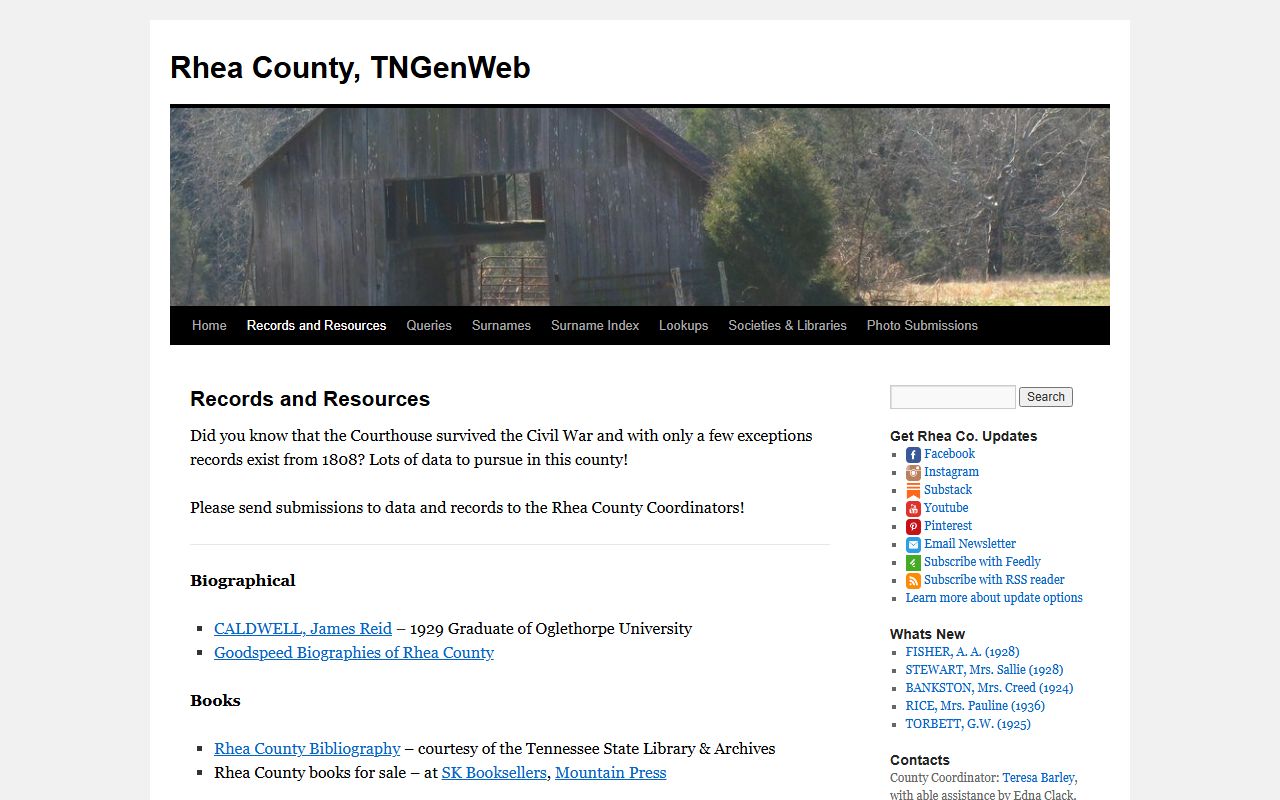
That page is especially useful because it gathers obituaries, county books, cemetery listings, and probate references in one place.
How to Search Rhea County Obituary Records
Start with the local death index and obituary pages. The Rhea County records-resources page notes Rhea County obituaries, cemetery listings, probate court books, and death indexes for 1908-1912 and 1914-1933. The Genealogy Trails death database adds a surname-indexed run of more than 350 entries from 1908-1912. Those two resources together make Rhea County one of the most straightforward counties in this batch for death research.
If you want more context, the county courthouse and clerk are a strong next step. The courthouse survived the Civil War with only minor exceptions, and the research notes say records exist from 1808. The county clerk handles marriage and birth and death records, and the chancery court has probate books that reach back into the 1820s. If the obituary names a spouse, child, or burial place, the county records can usually confirm the person quickly.
The FamilySearch wiki notes that early records may be found under Roane County for the pre-1807 period, so older family lines sometimes need a county-line check. It also says newspapers on microfilm at TSLA include Dayton, Rhea Springs, and Spring City titles. That matters when an obituary is missing from one paper but turns up in another. The Rhea County Historical and Genealogical Society's "Rhea Notes" publication can also help place a family or cemetery in the county story.
For state backup, the Tennessee death indexes cover 1908-1912 and 1914-1933, and FamilySearch and Ancestry are listed as places where Tennessee death records can be viewed or indexed. The Tennessee Office of Vital Records remains the place to request certified copies, and the research notes say the fee is $15 per copy. Under T.C.A. 68-3-205 and T.C.A. 68-3-206, access and copy rules depend on record age and requester status.
Rhea County also has a useful set of cemetery listings with Google map integration. That is a practical clue when a notice gives only a surname and a burial ground. The cemetery reference can move you straight to the right family branch without forcing a wide county search.
Note: In Rhea County, the obituary trail is often strongest when the county obituary page and the death index are used together.
- Full name and alternate spelling
- Approximate death year or record number
- Dayton, Spring City, or cemetery clue
- Spouse or parent name if known
- Newspaper or TSLA index reference
Those clues make the local record sets much easier to use.
The Genealogy Trails death records database is especially helpful for Rhea County because it is surname indexed and gives record numbers that can be used to match state certificates.
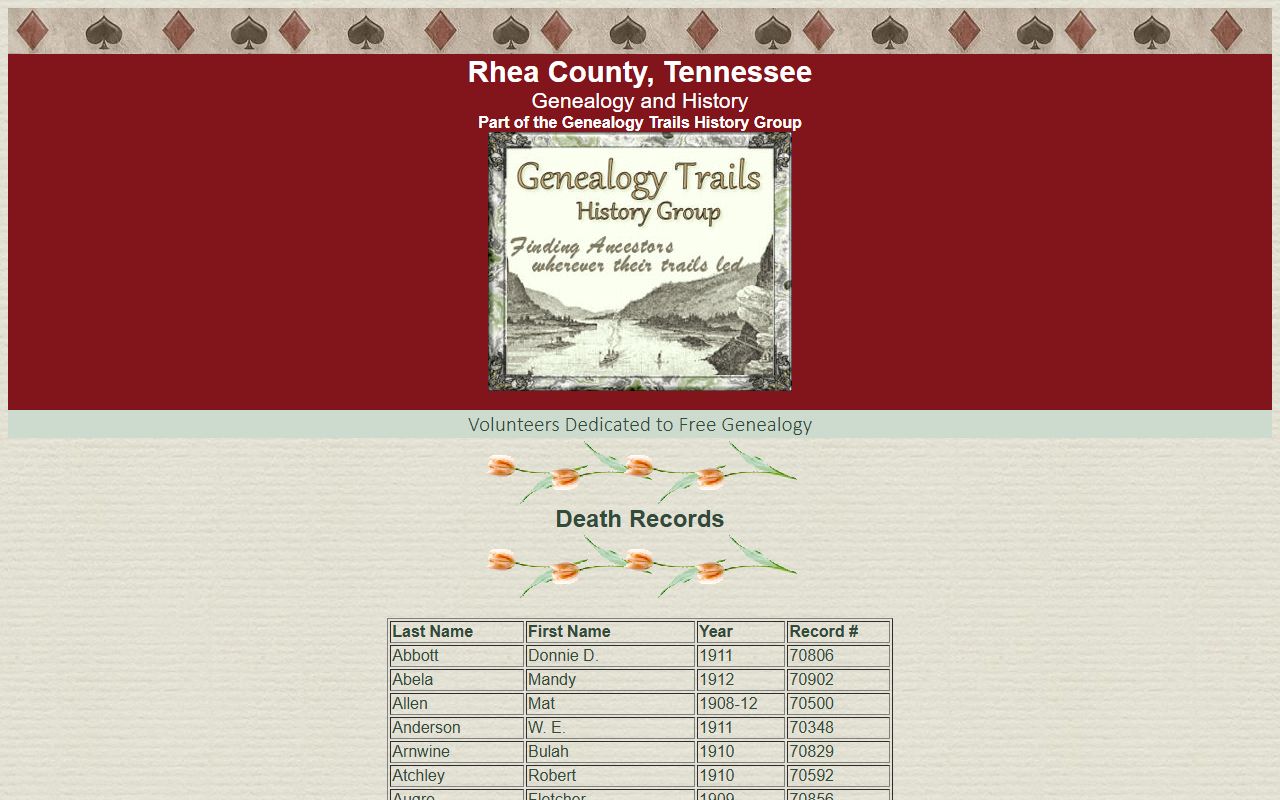
That image is a good reminder that Rhea County deaths are often easiest to track when a county index and a state certificate line up.
Rhea County Obituary Records and Death Indexes
Rhea County obituary records often connect to state death indexes very cleanly. The research notes say the TSLA index covers 1908-1912 and 1914-1933, and FamilySearch has Tennessee deaths and burials from 1874-1955 plus death records from 1914-1955 with free registration. That makes Rhea County a good county for combining local obituary work with state-level confirmation. If a person is in a county obituary but not in a newspaper clipping, the death index is often enough to prove the date and place.
The county also has a strong probate record trail. Original wills from 1825-1967 are noted as available at FamilySearch, and probate books are available for research. Those records can explain the family structure behind a death notice. If the obituary mentions an heir, a spouse, or a burial place, the probate book can often confirm the relationship.
The courthouse disaster history matters here because it explains why you may need multiple sources. Even though marriage records remain intact, some records were damaged in the fires. That is why the county obituary page, the death index, the cemetery listings, and the probate material all matter together. One source rarely does the whole job.
The Tennessee Office of Vital Records is the final source when you need a certified copy. Certified death certificates are $15 in the research notes, and the office handles current records. If the local obituary gives you a date but not a formal proof, that office is the best final check.
Rhea County is also one of the counties where local church, cemetery, and newspaper clues can all point in the same direction. That makes the search efficient once the first clue is in hand.
Note: Rhea County's obituary work is strongest when you accept that a county notice, a death index, and a cemetery list each solve a different part of the same case.
The Rhea County Historical and Genealogical Society publishes "Rhea Notes," which is useful when you need a family clue that a newspaper line skipped. It can help place a burial, church, or surname cluster in the county story.
That local context is what turns a death notice into a usable family record in Rhea County.
Browse More Tennessee Records
Rhea County fits into the broader Tennessee obituary and vital-records network. Use the browse pages when the family trail reaches another county or town.