
Stewart County Obituary Records
Stewart County obituary records are shaped by both Civil War history and a strong local library tradition. Dover is the county seat, and the county lost some records in an 1862 courthouse fire during the war. Even so, the Stewart County Public Library and the county record offices give you a reliable path into obituary research. Many Stewart County notices include family details, funeral notes, and burial places that help you rebuild the local line quickly. That makes the county a good place for focused obituary work.
Stewart County Quick Facts
Where to Find Stewart County Obituary Records
The best local starting point is the Stewart County Public Library genealogy page. It includes Stewart County census records, obituary material, family histories, county histories for Stewart and nearby counties, and free Newspapers.com access on library computers. That makes it one of the best county library resources in the batch for obituary work.
The county clerk and circuit court clerk are also important. Stewart County has marriage records from 1849, probate records from 1812, and court minutes from the early 1800s. If a notice gives you a spouse name or a family burial place, those records can help prove the same person. The county archive and library are especially helpful because the 1862 fire damaged some early records, so local researchers often need more than one source.
The first image below points to the Stewart County Public Library genealogy page, which is the county’s strongest obituary research tool.
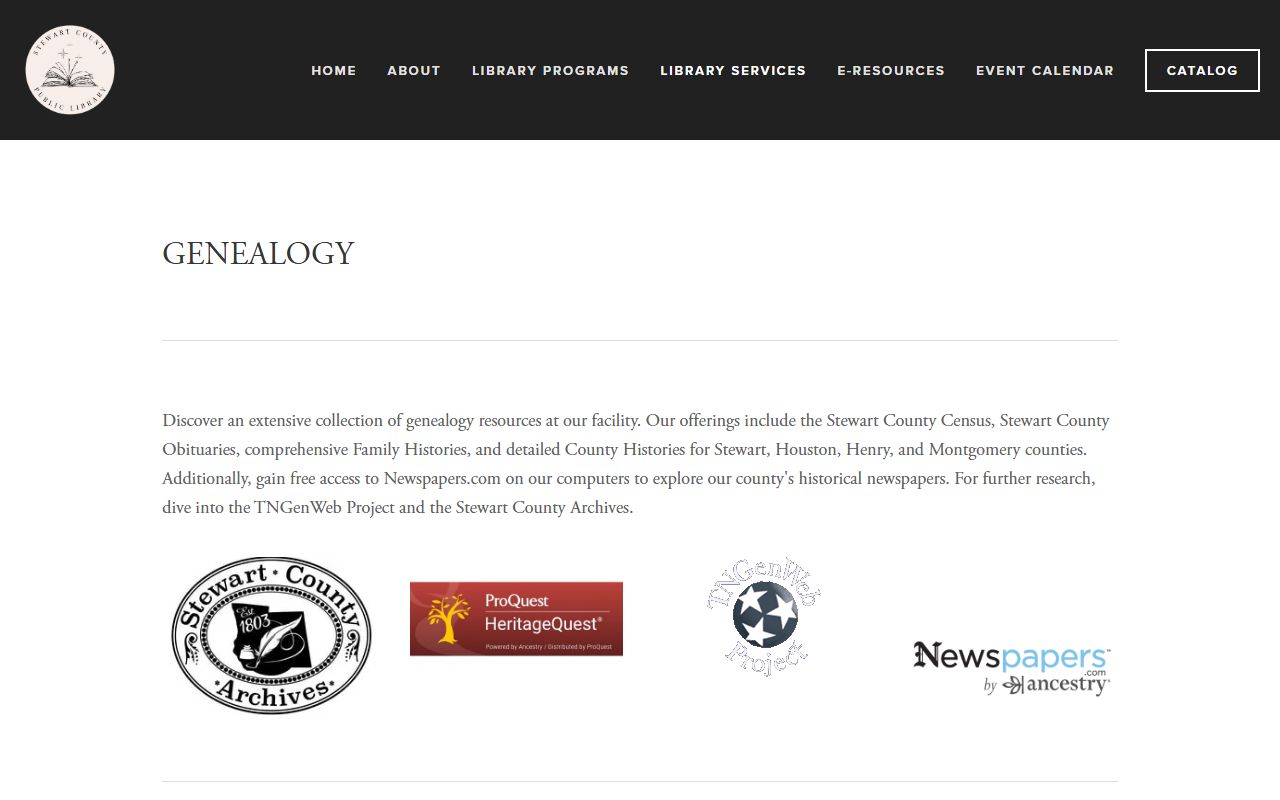
That page gives you a direct path into local obituaries and family histories.
For state support, Tennessee archives and vital-records pages help confirm deaths, marriages, and older record extracts. In Stewart County, the library and the county offices often do most of the work, but the state tools still help finish the search.
How to Search Stewart County Obituary Records
Search Stewart County obituary records by name and burial place if possible. Dover newspapers, county histories, and the library obituary collection can all carry useful details. The county has a strong history tradition, so a family may appear in a journal, a funeral home note, or a local obituary sample even when the first newspaper hit is thin. Fort Donelson history also means some families are tied to county memory in a way that helps with identification.
The Stewart County Public Library page often gives you enough context to keep the search moving. If the obituary mentions a church, school, or county family line, the library and county history collections can usually add the missing piece. That is especially helpful when the record loss has left gaps in older files. A focused obituary search here is often more about matching the right family than finding a long paper trail.
Use a simple order.
- Start with the Stewart County Public Library genealogy page for obituary and family history material.
- Check county marriage and probate records when the notice gives you names.
- Use county court minutes if the obituary mentions estate or family issues.
- Compare the local paper trail with cemetery and family history notes.
- Verify the death through state records when you need a formal copy.
That sequence works because Stewart County obituary research often needs both a library clue and a county record to overcome the 1862 fire loss. Once those two line up, the search usually becomes much easier.
Stewart County Obituary Sources and Archives
The Stewart County Public Library is the county’s key obituary repository. It keeps census records, obituary material, family histories, county histories, and historical newspapers on library computers through Newspapers.com. That is a major help when you need to see a notice in context. The library also has a genealogist available on Tuesdays and Thursdays, which can be useful when the surname is hard to pin down.
FamilySearch and TNGenWeb are both listed in the research as useful county tools. They add obituary-related context, newspaper references, and death record extracts that can help when the local notice is thin. Stewart County also has strong periodical coverage through Tennessee genealogy journals, and that can help with older family history research.
For broader verification, Tennessee state death records and archive tools are still worth checking. Stewart County obituary work is often a mix of local library records, county office files, and state confirmation. That combination usually gets you the full story even when the county fire loss left gaps.
Public Access to Stewart County Obituary Records
Obituary notices are public, but Tennessee rules still control the official records behind them. Death certificates are limited under T.C.A. § 68-3-205, and certified-copy access is explained in T.C.A. § 68-3-206. That means a notice in the paper may be easy to read, while the state record may need a formal request. In Stewart County, that is a normal part of the process because local records can be incomplete.
The Tennessee Department of Health Office of Vital Records is the state source for certified copies. If you only need the local story, the library and county history collections may be enough to start. When you need proof, the state record closes the loop. Stewart County’s library access makes the first part of the search especially efficient.
Note: Stewart County obituary research often works best when the library clue, county record, and state copy are kept together.
Getting Copies in Stewart County
For local copies, start with the Stewart County Public Library genealogy collection. If the obituary turns into a marriage or probate question, the county clerk is the next office to check. The circuit court clerk can help with older minutes when the family matter appears in court records. That order matters in Stewart County because the 1862 fire makes the library and the surviving county files more important than in some other counties.
For state copies, the Tennessee Department of Health Office of Vital Records is the final source. Stewart County researchers often get farther by using the library first, since the obituary collection and local histories can save a lot of time. If the obituary is older, the county history books and regional newspaper sources may be just as important as the official certificate.
Once the obituary, library reference, and state record match, Stewart County research is usually complete enough to trust.